


Starborne: The Journal of Autocosmology, Issue 1, can be read in full at the above link. Each individual contribution will be shared here as well, one every week.
Wild Pilgrimage
By Geneen Marie Haugen
At the holy well in Glastonbury, England, a cluster of women and men place crystals—citrine, amethyst, rose quartz—on the flat gray stones that circle the wellhead’s opening. Others suspend necklaces and amulets over the water. I hear someone whisper that the crystals and amulets are getting “charged.” One woman tilts back her head and spreads her arms wide, face and palms uplifted to the sky, talisman dangling from a silver chain entwined in her fingers. Most of the women wear flowing garments in colorful shades, like the flowers of the garden—purple, lavender, lemon, crimson, or cobalt. One man wears a black t-shirt with a goddess figure on the back.
Elsewhere in the Chalice Well garden, people walk slowly, reflectively, from holy thorn tree to holy yew, tying ribbons to branches or placing offerings at the base of tree trunks. Some of the ribbons are written in an indecipherable script. Another reads, “May your dreams flow through us.” It is not clear whose dreams are intended to flow. It occurs to me that someone must untie the ribbons every evening; someone must carry away all the coins offered to the pools, the stone beads, and written prayers left on the garden’s ground.
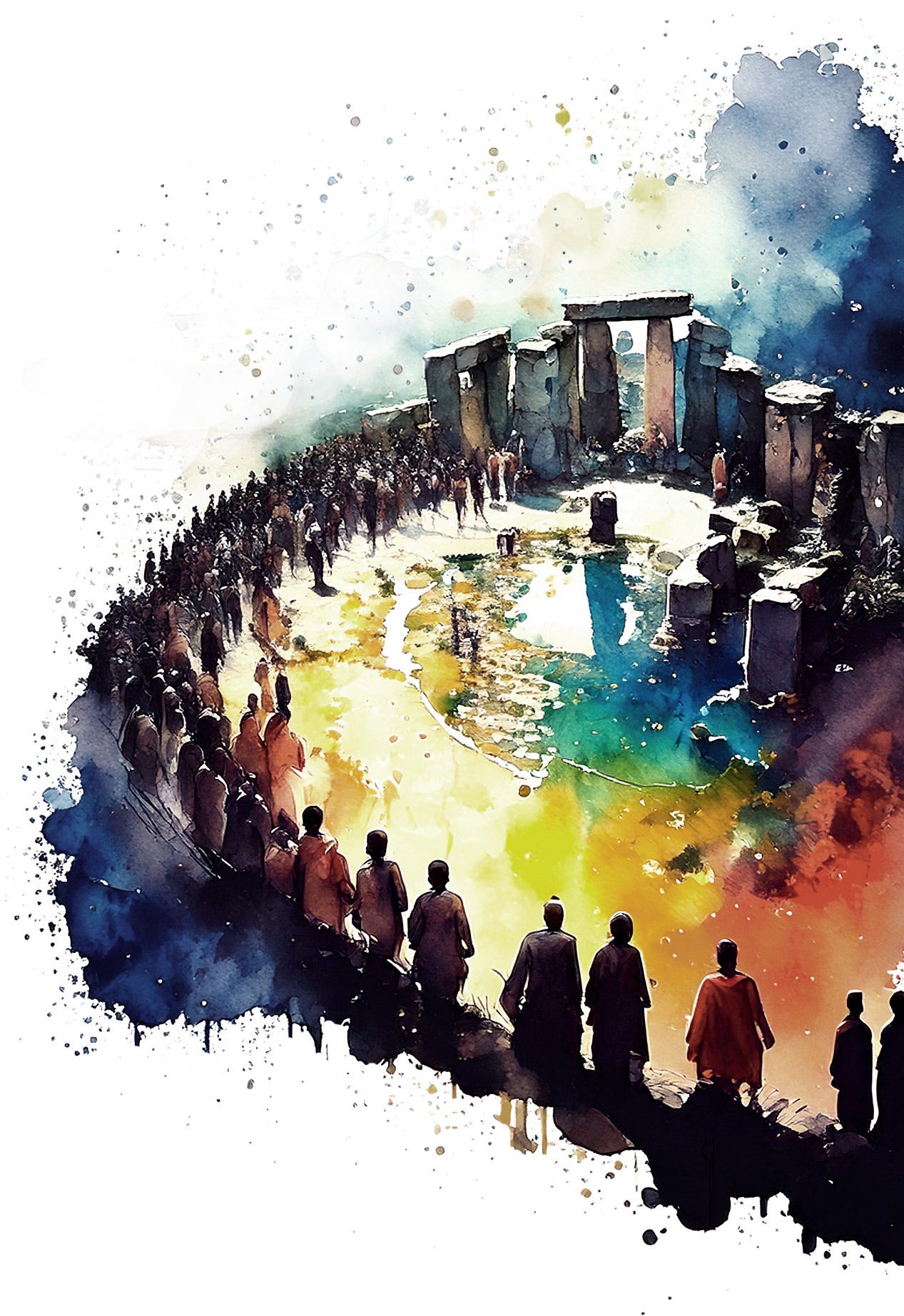
I am exquisitely capable of cynicism about the seeming new age earnestness of these pilgrims, except that the longing for intimate relationship with the mysteries of the holy Earth—sacred water, stone, tree—is palpable to me, and familiar. I carry my own longing for communion with the intelligent, animate, ensouled Earth. At the Chalice Well, I drink iron-rich water at the spouting Lion’s Head; I step barefoot into the Healing Pool; I sit in meditation by the rusty Vesica Pool. Archaeological evidence suggests that pilgrims have been traveling to these waters, which flow at a constant rate and temperature, for at least 2000 years. I imagine that pilgrimage did not begin with the Christian era, but thousands of years earlier, perhaps even before the great stones were mysteriously raised at nearby Avebury and Stonehenge.
The ambiance in the Chalice Well garden is reverent. Even people who may be on the tourist circuit—rather than spiritual pilgrimage—speak in hushed tones to one another. No one talks to a smartphone. There are no loud voices. No one runs, or appears to be in a hurry. I’ve always hoped for similarly gracious mindfulness from those gathered at, say, Old Faithful, Yosemite Falls, or the rim of the Grand Canyon.
I came upon the Chalice Well by chance, not as a purposeful pilgrim; I simply happened to be in Glastonbury, unprepared for the array of prehistoric sacred sites or for the bustling modern streets lined with shops devoted to magick, goddesses, fairies, crystals, Merlin, Arthur, Avalon, tarot, channelers, Druids, psychic healers, ley lines—a metaphysical banquet, a commerce of ancient mysteries, a dim reminder of a time when trees and wells, stones and hilltops were still animate, still possessed their own genius loci, or spirit of place.
***
If there are sacred wells in the American West, where I live, I don’t know where they are. But I do know locations of springs, hot and cold—springs that are holy, at least to me, a few friends, and perhaps to unknown others, perhaps even to many unknown others. I have been a pilgrim in all seasons, at all hours, at one particular hot spring for more than thirty years. My own offerings to the water might be poetry, or wild prayers, a simple flute melody, or small bundles of feathers and sage tied with the twisted hair of bison I’ve collected from nearby lodgepole. My offerings are gratitude for water emerging from the fiery heart of Earth, gratitude for places wild enough for bison, elk, and grizzlies. Gratitude for all the times I’ve been a pilgrim in the absence of shouters and shriekers, cell signal-seekers, or drunken revelers. And gratitude, especially, for the Big Questions that arise while lying in steamy water beneath the glittering sky: Do human beings have a purpose on this astonishing planet? Why are we here?
At the Chalice Well, I am reminded of an evening more than two decades ago, when I was fortunate to be present in an auditorium with the Dalai Lama in Santa Cruz, California, just days after the announcement that he would receive the Nobel Peace Prize. The air in that sold-out venue nearly crackled with attention; there was a felt sense that a truly noble being, a great spiritual teacher, was among us. And I wondered if—like the maroon and saffron monks’ robes—the numinous atmosphere always accompanied the Dalai Lama, whom many regard as a holy man, or if it was also us, our attention, our deep respect and honoring, and our anticipation of his Holiness, that sent the air aquiver. Did the evening feel extraordinarily alive because we approached it as if it were a sacred occasion?
At the Chalice Well in Glastonbury, the mystically-tinged atmosphere in the gardens is distinct from the flurry of commerce not so far from the gates. There is reverence toward the yew and holy thorn trees, toward the lush plantings, and of course, toward the well and the ever-renewing water itself. There is a feeling that the well…might…actually…be holy.
And of course I wonder. Is the Chalice Well more holy than other places, or does it feel numinous because pilgrims regard it with awe and reverence, as if a respectful attitude matters? Do the springs to which I make pilgrimage feel like a wild shrine to me because I make offerings, because I praise, because I approach the watery lands as if the manner of my presence matters, as if the land and creatures are aware of my intention? Does land—like human beings, like our companion animals—vibrate with subtle enlivenment in response to our attention, our acclamation or devotion?
I don’t know if there are any lands more sacred (or less) than others, though there is surely a difference in how we treat the various faces of Earth. If our collective perception of the world allows us to regard some places as less worthy, less valuable, less consequential than other places, have we already flung open the door to strip mines, fracking, nuclear waste disposal, and other everyday desecrations?
What would the world become if we treated every place—our backyards, national parks and watersheds, spines of mountains and labyrinthian canyons, fiery geyser basin and superfund sites—as if it were sacred, essential to our own florescence and vitality, imbued with its genius loci, worthy of pilgrimage, worthy of our offerings, attention, and acclamation? Who do we become if we address the world in such a way, if we learn to address the Earth community as “thou”—or as our larger Self?
What if approaching the world as if everything is alive and sensing reveals a breathing, trembling, shimmering presence that has been near, all along, at the edge of our ordinary awareness? What new contours might the world take if we addressed the other-than-humans amongst whom we dwell as animate, intelligent, expressive, and suffused with their own noble longings? What if everything depends on this?
I ask myself these questions as I gather wild prayers for Earth, prayers to weave together with sticks and dried grass, prayers to carry in offering to the land. I do not know for sure if it matters to the other-than-human world; I do not know if it matters that I sing for the return of wolves and bears and trout, for the restoration of land injured by dams, coal mines, logging, gas fields, pesticides, cattle, wars, corporate ecocide—the litany is endless. I don’t know if flute music is of any consequence to the furred, feathered, or leafy others; I don’t know if offering a rough nest of wild prayers as part of my backyard pilgrimage makes a difference to anyone but me. I do know that such acts erode my ordinary way of seeing and being. For a time, I am no longer simply an observer. The pinyon, meadowlarks, and sage pulse with invitation, and I approach with offerings, gratitude, and praise, as a participant in an animate world.
Geneen Marie Haugen, PhD, grew up a little wild, with a run amok imagination. A content creator and guide to the intertwined mysteries of nature and psyche with the Animas Valley Institute (www.animas.org), she has also been on the faculty of the Esalen Institute and Schumacher College. Her writing has appeared in Spiritual Ecology: The Cry of the Earth; Thomas Berry: Dreamer of the Earth; Parabola; Kosmos Journal; Ecopsychology, and many others. She believes in the world-shifting potential of the human imagination allied with the planetary psyche.